
A Culture Tour to Bruges, Ghent, Antwerp and Delft

27 October - 5 November 2026
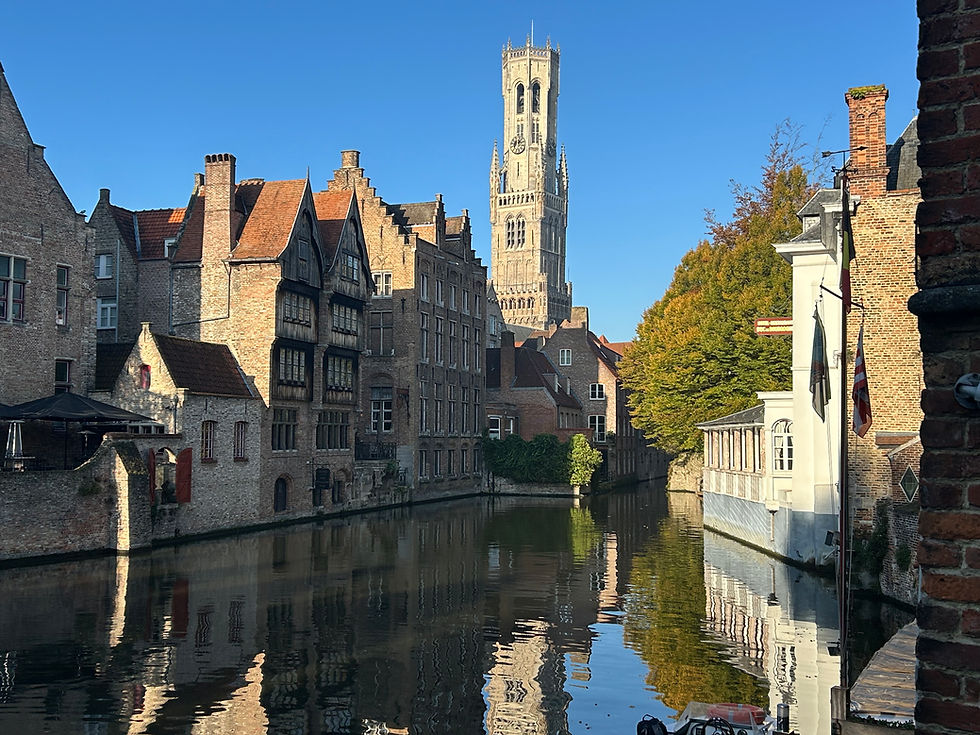
I don’t want to put off my readers but this is a culture tour.
The plan is to see the glories of Bruges (one of which you can see above) and Ghent, both of which I’ve been to before but so long ago that I’ve almost no memory of them, as well as Antwerp, before crossing the (probably non-existent) border to Delft in the Netherlands. It was all successfully accomplished, despite three significant disappointments, as to which more below.
I planned it all with the help of the great travel firm Kirker. I sat down with them (literally) and explained what I wanted. They then book the hotels, get the various tickets and advise how best to travel. Answer, by train: - Eurostar to Lille; car to Bruges; then train, train, train and train again.
Excellent.
Getting there
Kirker has high standards. For example, they book things First Class. Normally, I’m rather mean and frugal, travelling, as I often do, in standard class, wondering whether a bit more leg-room is worth an extra 100 quid. But Kirker don’t demean themselves by even asking the question. I go to Lille on Eurostar Plus, which is what they call First Class, so as not to sound too posh and elitist, I guess. Certainly much more comfortable, with a light (very light) lunch thrown in. Maybe this will change my life.
And then on to my first destination Bruges by chauffeur driven car. All motorway. Nothing to complain about.
Bruges
In Bruges I am installed in a very boutique hotel called Pand (pronounced like a “punt” on the River Cam in Cambridge). It is very central. Step outside the front door and a few yards away is the famous view of the Belfry, one of the most photogenic and indeed photographed views in Europe. Including by me - see above and below.

The history is interesting. In 1500 Bruges was one of the biggest and most prosperous cities in Europe - maybe in the world. Its business was importing wool from East Anglia and turning it into cloth. Their population was about 200,000 whereas poor little London was then only about 75,000.
But then catastrophe. The river silted up. Ships couldn’t get in and the businessmen moved to Antwerp. The happy result was that it got largely ignored. Specifically, no one found it worth bombing during the various wars - or indeed developing with horrid modern buildings. Bruges is significantly as it was back in the 15th century and can concentrate on welcoming and entertaining the tourists - and art lovers like me.
Museums in Bruges
There are three main museums in Bruges: one is a church; one is an ancient former hospital; and the other is the main fine art museum. My favourite was the hospital.
Memling Museum
It’s a little confusing. It’s called the St John’s Hospital Museum, as well as the Memling Museum. It is all contained in the medieval hall that was the hospital. There is a certain amount about the splendid work of the hospital back in the days when they couldn’t do much more than care for the dying, with the occasional amputation. I shamefully marched fairly quickly through this part.
A section of the building is set aside as the Memling Museum, containing some wonderful paintings by Hans Memling, including a triptych showing (appropriately) the various St Johns, with the Baptist having his head chopped off on the left and the Evangelist on the right recording his Revelation on the Island of Patmos. See below. (I had thought that the Revelation was written by yet another St John, but here it’s the Evangelist, seen below on the right busy writing it all up.)

The key work by Memling is the beautiful shrine to St Ursula, which had me looking up her story. She is thought to have been partly English and refused to marry whoever she was meant to. She went to see the Pope, accompanied by 10 virgins. But the legend gets better than that. Each virgin had 1,000 virgins with her - making a lot of virgins. They ended up in Cologne where, for reasons history doesn’t divulge, they were martyred. The shrine is small and the paintings by Memling glorious (he only manages a modest number of virgins).

Groeningemuseum
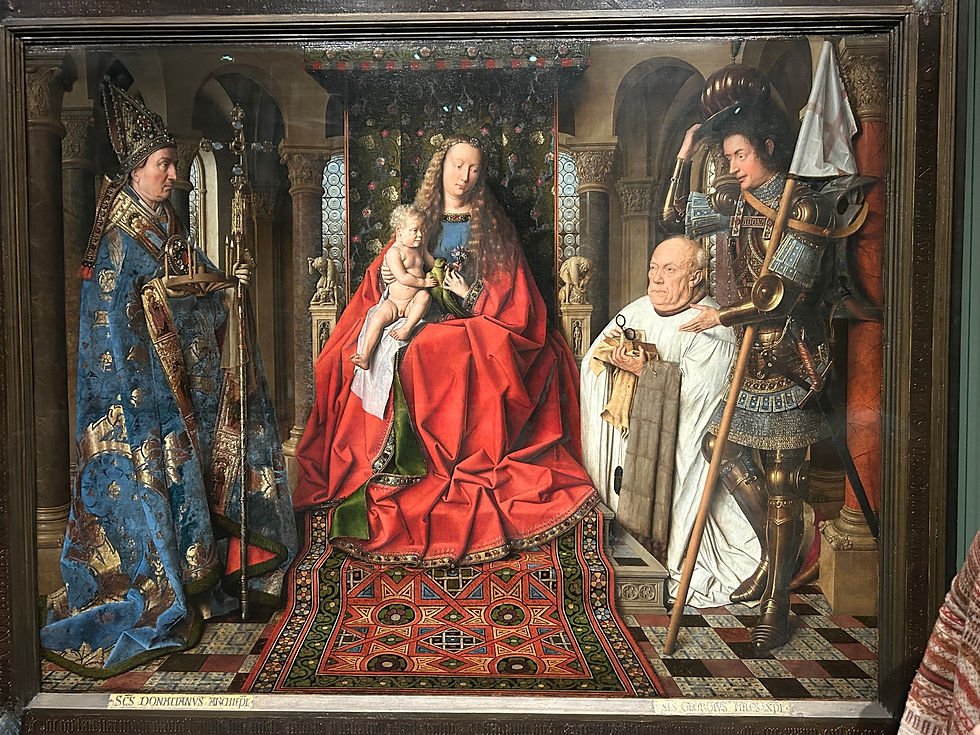
The main museum is the Fine Arts Museum, known now as the Groeningemuseum. It has paintings by
Jan Van Eyck, the outstanding one being a Madonna in rich colours, but also containing a portrait of the
donor, which is famous and must be one of the most realistic representations of anyone from that era (the elderly man in the white cassock).
O-L-Vrouwekerk
The third museum is a church, namely the Church of Our Lady or, in Flemish, the Onze-Lieve-Vrouwekerk. (Although almost everyone speaks English, there are a lot of monolingual signs in Flemish, which are not easy to decipher - for example, the name of this church.)
Its prize exhibit is a surprise - a small statue of the Madonna and Child by none other than Michelangelo. It was commissioned by one of the prosperous denizens of 16th century Bruges and had a rough history. Napoleon stole it and it was only returned after he had been sorted out by us and the Prussians in 1815. Then, of course, the Nazis stole it and after the War it was discovered in Austria, whence it again came back to where it belongs.

Mary of Burgundy and Margaret of Austria
I also had an interest in a tomb in the church, namely the tomb of Mary of Burgundy. Interesting to me because she was the mother of Margaret of Austria, having been married to Maximilian I, Holy Roman Emperor. Margaret of Austria is buried in a magnificent tomb in the Monastery of Brou, just outside Bourg-en-Bresse in France - which is one of my favourite stopping places when I drive down to the south of France. It all relates to the times around 1500 when what is now Belgium was part of Burgundian territory. As I say, interesting to me, but maybe not to others - sorry! But I heartily recommend a visit to the Monastery of Brou, one of the great treasures of France.

Ghent
Kirker advised staying in Bruges and doing a day trip to Ghent, rather than staying there. Absolutely right. Ghent is a bigger place: much more traffic, more people - and trams. But I mustn’t knock it. There are attractive ancient buildings in the centre by the various canals. It just doesn’t have the charm of Bruges.

The Mystic Lamb
I made straight for St Bavo’s Cathedral (Sint Baafskathedraal), the home of the greatest work by Jan Van Eyck (and his less well-known brother Hubert), the altarpiece referred to as the “Mystic Lamb”. It was the first of my disappointments, but as I’ll explain, not very disappointing.

But first, the altarpiece itself. It has its bizarre aspects. Centre stage, as shown above, is an altar on which the symbolic lamb is standing, looking rather surprised, with blood flowing out of its chest into a chalice sitting conveniently beside it. But the total image showing crowds of saints, angels and others (maybe virgins?) is impressive.

The whole altarpiece resides in a separate glass container. You have to have a timed entrance ticket, which of course I had, thanks to Kirker. The glass container makes it a little more difficult to appreciate
than paintings hung normally. Which brings me to my “disappointment”.
After leaving it, I read that it’s being restored. It’s on two registers, one above the other. Apparently, the upper panel is being restored. What had I just seen and admired? And indeed taken a photograph of? Answer: an amazingly clever photographic copy! I challenge anyone to see the difference between it and the lower original.
But there was a benefit in all this. Before leaving Ghent, I went to the Fine Arts Museum. And there, to my great surprise and pleasure, I was able to see the original panels, each on an easel, in the process of being restored. The two panels showing Adam and Eve respectively indicate what a good job the restorers are doing.
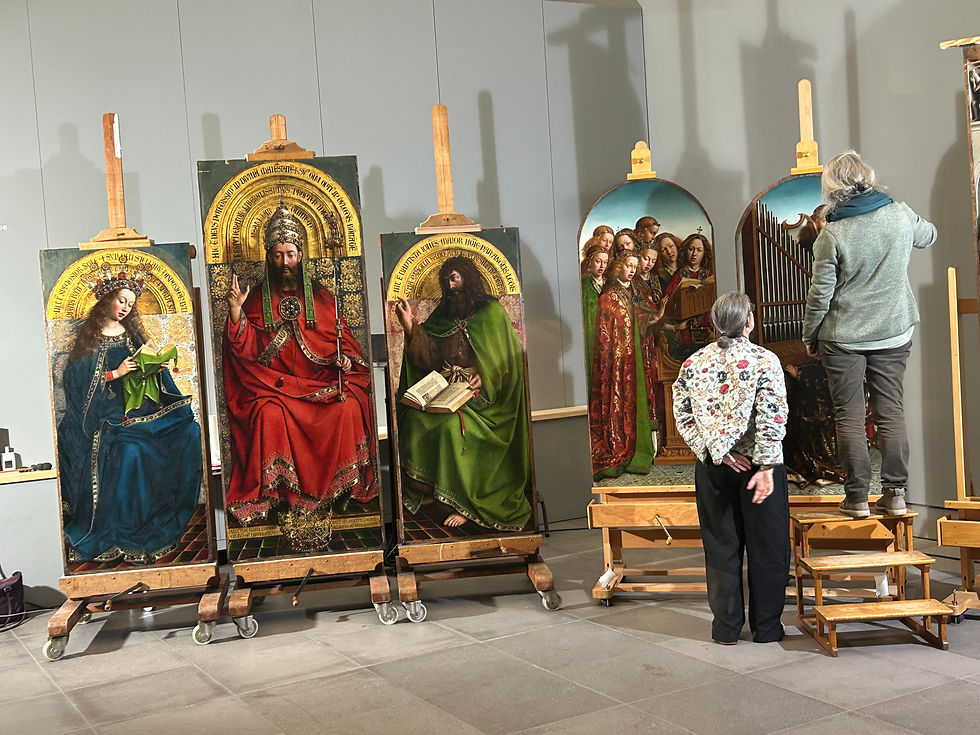
The altarpiece has had a history even more alarming than that of Michelangelo’s small statue. In the
18th century the Hapsburg Emperor Joseph II had the Adam and Eve panels removed as they were too shocking. During the French Revolution and Napoleonic era, it went on its travels, being returned after 1815. During the War it has hidden in a salt mine in Austria, then to be retrieved by the Americans and returned home.

Lamb of God
Lambs seem to play a more important part in the medieval symbolism of Flanders than they do further south - and certainly than they do in England. Obviously, this is very evident with the Ghent altarpiece. But lambs put in regular appearances in many other paintings, often standing patiently in the background, presumably wondering when they’re going to be sacrificed.

Antwerp
After Bruges I go to Antwerp. From the cultural point of view, this represents a major change. We move from the 15th century “primitives”, like the Van Eyck brothers and Hans Memling, to the baroque splendours of the 17th century, particularly Peter Paul Rubens.
Boutique experience
I find myself installed in another very boutique hotel, the t’Sand (again, pronounced “tsunt”). All very modern, not exactly cosy. The most curious feature is the bathroom, which is perhaps worth noting as I’ve seen it elsewhere. The bathroom isn’t just en-suite, it’s part of the bedroom, divided from it in this case simply by a tinted glass wall. This means that you can watch your companion having a shower (fine, perhaps), but also watch him or her going to the loo (not so good). Who lusts after that particular experience, I ask myself.
Antwerp Cathedral

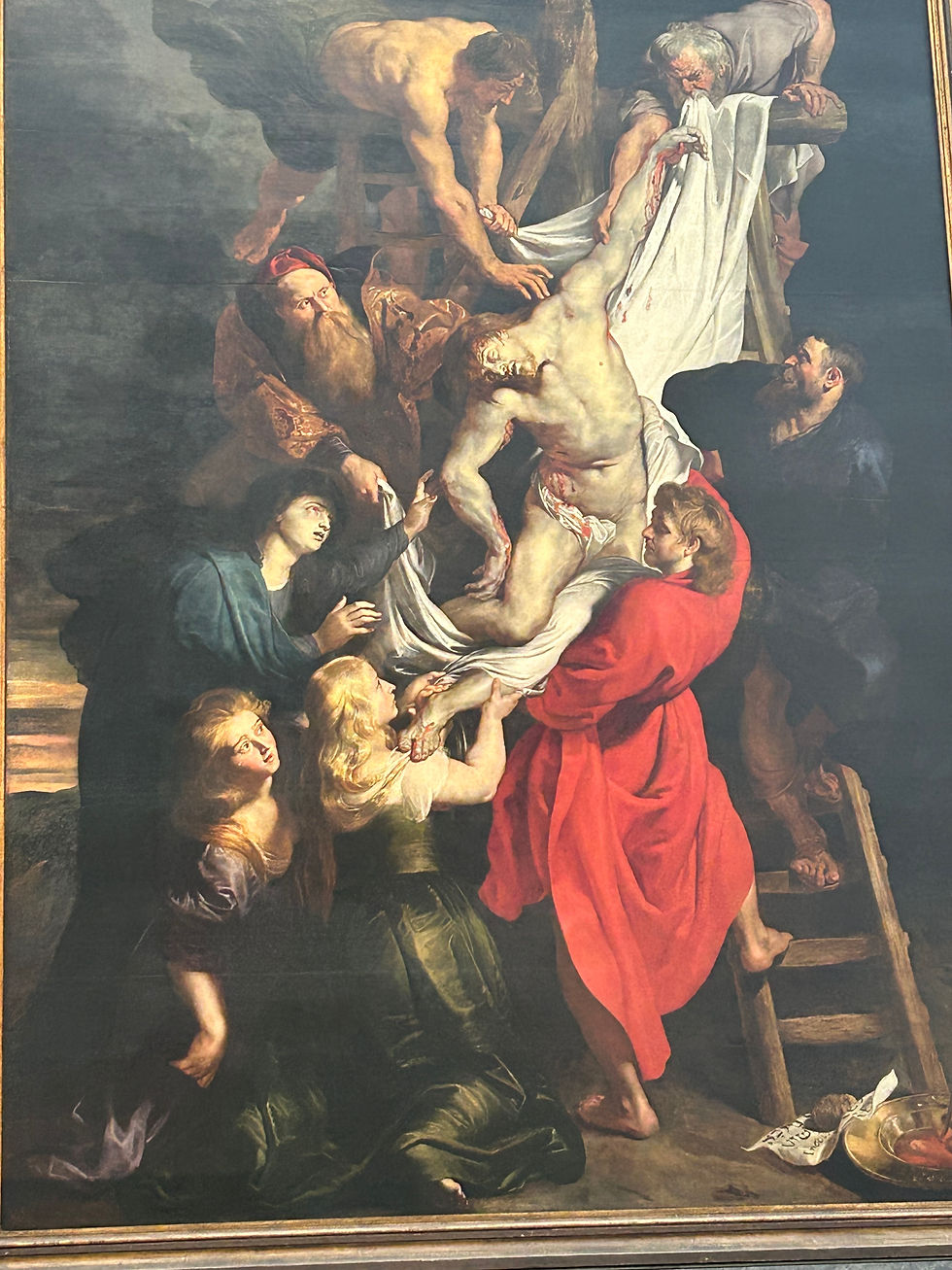
The cathedral has four massive and impressive paintings by Rubens, one of which (inevitably) is being restored. But two of the others are among his greatest. One is Raising the Cross (above) and the other the Descent from the Cross (below). Both, to my mind, are masterpieces of the kind of vigorous and powerful movement that he handled so expressively. They also both include some of his wonderful images of highly believable individuals.
Fine Arts Museum
The Fine Arts Museum is where I had the second of my disappointments - a real one this time.
One of my objectives was to see Rubens’s Adoration of the Magi, partly because I know it to be one of his most impressive paintings, but also for a more personal reason.
When I was at King’s College, Cambridge, as an undergraduate, a painting of the Adoration of the Magi by Rubens was very kindly donated to the College. It was installed in the chapel with some difficulty and much controversy, partly as it involved physically modifying the east end of the revered building. I was keen to compare it with the one in Antwerp.
But no, I discovered that it was (you’ve guessed!) being restored. And it had not been replaced by a copy - good, bad or indifferent. All you could see was the original lurking behind massive scaffolding. I managed to take a few photographs through the gaps, some showing Rubens’s fantastic skills in characterising some of the individuals - and indeed the camels.

Delft

Then on to Delft, moving (without noticing it, of course) from Belgium to the Netherlands.
Delft is lovely - peaceful, almost entirely free of cars, largely because, with all the canals and narrow streets bordering on them, driving a car would be a nightmare. My taxi from the station to the relatively central hotel where I was billeted had to take a tortuous 15 minute route. Walking back took less than five minutes.
My hotel in Delft was by no means boutique. It was large, cleverly constructed out of an old armory - hence the name, the Hotel Arsenaal by Westcord. The passageways are slightly reminiscent of an almshouse. Comfortable and efficient, but not cosy.

Vermeer
My reason for going to Delft, apart from the fact that I had never been there, was because of my renewed interest in Vermeer, having been much interested in the art historian Andrew Graham Dixon’s recent book on the painter. He has done some amazing research and discovered that Vermeer was part of a somewhat secret and beleaguered protestant group called the Remonstrants or a sub-group the Collegiants. They met in a secret church hidden behind the buildings shown in Vermeer’s famous painting “The Little Street”, now in the Rijksmuseum. I would like to include a photo of the painting but I didn't go to the Rijksmuseum.
I made an attempt to find where it was, following the leads given in Andrew’s book. He maintains that you can still detect some of the buildings, despite all the rebuilding over the last few centuries. Frankly, quite a stretch! This is what is there now - as shown below.

But the church still exists, so he says, even though it’s no longer a church. You can reach it now through a doorway that’s no longer anything like what it was (the brown wooden door in the picture above). I rang the bell and was completely unsurprised that there was no answer. Next to it a workman (non-English speaking, unusually) was busy but clearly had no idea about it.
Vermeer Centrum
I had more luck with the museum, which they call a “centre” not a museum because it doesn’t actually have any paintings by Vermeer - or anything else, as it’s an information centre.
What it does have is a blow-up photograph of each of his 34/37 known paintings (the number varies because of uncertain attributions). This enables someone like me to have a happy time examining them in a way you can’t realistically do in a museum - and anyway they’re scattered round eight countries, including one in Japan.
The Graham Dixon thesis
Andrew Graham Dixon maintains that many of the paintings have a hidden religious meaning. There’s no doubt that most of them were painted for and owned by one of the key members of the Collegiate religious group, who lived in the house depicted (in part) in the “Little Street”.
But some of the religious symbolism leaves me struggling. The one that I find most convincing is a tiny thing in two paintings that were clearly painted as a pair, although now separated, one in Amsterdam (the Milkmaid) and the other in Washington DC (Woman with a Balance). In both, there is a meticulously painted nail on the wall prominently behind the woman in the picture - not to be found in any other painting. Andrew says that they are symbols for the nails at the Crucifixion. I don’t make it sound very convincing! But I wonder whether there is another explanation. Just chance? Coincidence? Not very likely. Maybe he’s right.
Delft churches
Vermeer was buried in the Oude Kerk (Old Church). Now there’s just a memorial in the ground.
The most important church in Delft is now the Nieuwe Kerk (New Church), which has become the burial place of Dutch royalty. It’s only “new” in relative terms. It was there in Vermeer’s day and appears clearly in his “View of Delft”.
The Nieuwe Kerk is light and beautiful, the nave having been stripped down to the brickwork, in what may be typical Dutch fashion. Over the centuries, various waves of iconoclasts have done a pretty thorough job of destroying statues and memorials.
The church was the burial place of William the Silent, founder of the nation. It has since been the resting place of most of the subsequent stadtholders and monarchs belonging to the House of Orange. One exception is our own William of Orange, King William III, who, as I was told (correctly) by one of the attendants, is buried in Westminster Abbey.
View of Delft
Before leaving Delft, I walked over various bridges to get to the place where Vermeer painted his famous “View of Delft”. I was half expecting a difficult search; but no, there were various notices telling us all about it and even binoculars, though the gadget didn’t seem to be working. Frankly, the buildings that Vermeer saw and painted are no longer there, with one exception, the New Church which is highlighted in the picture in patchy sunshine.

The Hague
My final destination was The Hague. This was to see a former colleague, unrelated to my culture tour.
But I was looking forward to a visit to the Mauritshuis to see the Girl with a Pearl Earring (of course) but also, indeed mainly, the View of Delft, having read about it in Andrew Graham Dixon’s book. And also to look again at the yellow wall in the picture, as admired by Proust. But it was my third disappointment. It wasn’t there. It was on loan to the Thyssen-Bornemisza Museum in Madrid. Very annoying!
Endnote
I must end on a positive note, after mentioning these “disappointments”, one of which wasn’t a disappointment at all.
Normally wherever I go I feel that I am followed by rain and dreary weather. But this time, absolutely not. I had clear blue skies almost all the time, even though it was November and definitely autumnal. And the forecasts for the following week were appalling. How lucky I was!
And the tour was a great success.
Tony Herbert
9 November 2026


Comments