
FLORENCE - 2026

Updated: Apr 27
9-16 April 2026

I was first exposed to Florence at school, in England, not of course in Italy. I sat at the feet of a Mr C.R.N. Routh, my tutor, who was in the habit of giving us, his students, lectures - very informal lectures - about Italian Renaissance art, accompanied by coloured slides. I still remember which artists he covered, imbibing the views of the renowned American art historian, Bernard Berenson, as relayed by the said Mr Routh.
I’ve been hooked on Florence ever since. Over the last 70 years (horror!), I have been a keen visitor, seeing most of the things that tourists flock to see. And here I am now, staying for a few days with my brother, Mark, and his wife Shirani, who have a house in the city and have also caught a variant of the same virus.
With all this in mind, we had decided on a project - so as not to be overwhelmed by the richness of what the city has to offer, and maybe see some new things.
The Project
Our project was to see the various paintings of the Annunciation. I hope this doesn’t sound too recherché, or indeed tedious and boring. It follows a successful plan we had a few years ago to see the paintings of the Last Supper, which was fun and interesting. Why not repeat the exercise - with a different subject?
Planning
I have to kick off by stressing that any visit of this kind in Italy has to be planned. The Italians seem to organise opening and closing times so as to challenge the most patient visitor. Some churches or museums close at midday and don’t open till late afternoon (after all, custodians and vergers must have their lunch). Others curiously only open in the afternoon - or indeed the morning. And many are closed on a particular day of the week, probably the very day you were planning a visit.
The planning fell to my brother, who prepared an amazing schedule, involving much consultation of websites, but happily including refreshments, lunches and dinners along the way.
Arrival
Plans don’t always work out.
On my arrival at Florence airport we were confronted by a crisis, caused by the modern mania for making inane regulations.
My brother found at the last minute that he couldn’t rent a car. Avis maintained that as he had an Italian bank account and an address in the city he was resident in Italy (which he is not). On this basis he had to have an Italian driving licence (which he doesn’t). Check-mate!
Luckily I had my UK driving licence with me. So I could rent the car he had already ordered - as a tourist. Conclusion: a tourist from, say, Venezuela with a driving licence issued in Caracas can rent a car; but a Brit with a British licence and an address in Italy - and presumably greater familiarity with Italian roads - cannot. Who devised this rule? Is it a punishment for Brexit? Does it apply to Americans like Bernard Berenson’s modern equivalents? I bet it doesn’t apply to the Swiss.
The Annunciation trail
The first stop on the Annunciation trail was, appropriately enough, in the great Medici family church, San Lorenzo. But before we get into any detail, we need some background.

The Annunciation provided a challenge for your 15th century Florentine artist. How to depict an angel delivering an important but unexpected message to a young woman, at the same time as indicating all the theology behind it? You can see one of the best-known examples above.
St Luke is the only source. (Matthew doesn’t have the angel talking to Mary at all - he has the angel telling Joseph, in a dream, not to worry about his wife getting pregnant without his having had anything to do with it.)
Luke tells the famous story: the Angel Gabriel tells Mary that she will have a child by the Holy Ghost; but the artists (or some of them) felt the need to give clues about the theology, namely that it would ultimately save us from the sins that go back to Adam and Eve being kicked out of the Garden of Eden, and that the virgin birth had been foretold by the prophet Isaiah. Quite a job getting all that into a fresco!
Don’t be alarmed. I won’t be describing all the pictures of the Annunciation that we managed to see - with much enjoyment. And there are a lot of them. But I will make this minor observation. The early ones, such as the world-famous one by Fra Angelico (above), do have tiny representations of Adam and Eve leaving the Garden of Eden (top left), and an image of Isaiah making his prophesy (in the spandrel above the arches), and indeed the Holy Ghost in the shape of a Dove winging its way towards Mary. But later in the 15th century, by the time we get to Botticelli and Leonardo da Vinci (see below), all this gets forgotten, and we see more focus on the figures of the angel and Mary, not the theology. It seems to reflect the transition from the Early to the High Renaissance.
San Lorenzo
As I’ve already said, our first stop was in the church of San Lorenzo, the Medici family church, best known for the Michelangelo statues on the Medici tombs in the New Sacristy, which we certainly were not going to join the long queues to see. (I can’t resist remembering Alan Bennett’s naughty comment that Michelangelo’s women look like men “with tits put on with an ice cream scoop”.)
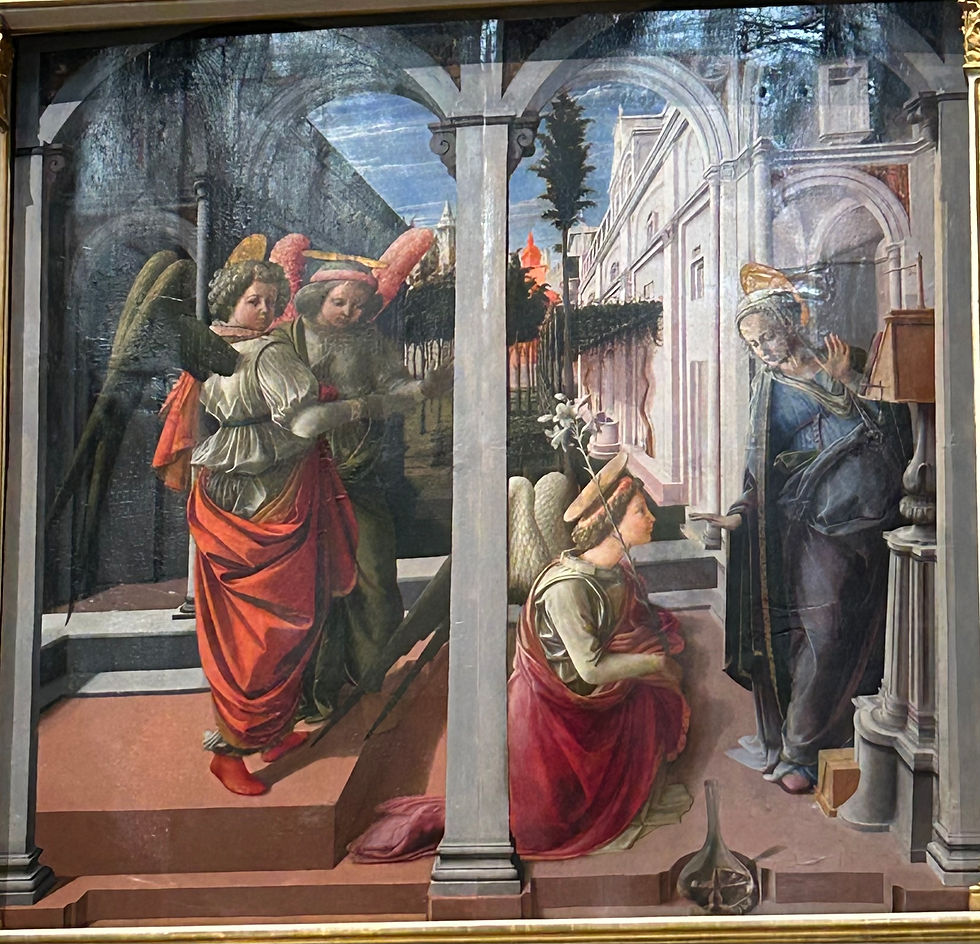
There is an Annunciation in the church itself - one of the most beautiful of them all (below). It’s by Filippo Lippi, who was a monk but, in Giorgio Vasari’s words - or at least his words as translated - was "lustful". He ran off with a nun, by whom he had a son, Filippino Lippi, who became a renowned painter like his dad. The painting doesn’t have much about the theology although there is a curious object under Mary’s feet. Does it have some cryptic meaning?
Santissima Annunziata
The next stop was very different - even bizarre. The church itself, the Santissima Annunziata, is one of the most heavily decorated that you’ll find anywhere - even in Rome. In one of the side chapels the clouds and the angels lying on them seem in danger of cascading down onto the altar below.
In another side chapel or “tabernacle”, also highly decorated (“incongruous” according to the Blue Guide), there is the most curious of the depictions of the Annunciation. The legend has it that it was painted by a friar who was miraculously helped along by an angel, with the result that it has miraculous powers (see below). It’s not one of the greatest from an aesthetic point of view, but the tabernacle is a focus for much religious devotion. Whenever I went into the church, a Mass was being celebrated there.

Spedale degli Innocenti
The Spedale degli Innocenti, the foundling hospital, is in the Piazza Santa Annunziata and is famous for its long colonnade of arches by Brunelleschi that are reckoned to be one of the first examples of Renaissance architecture. It’s also famous for its lovely medallions of babies on the colonnade by Andrea della Robbia. And less famous for a lunette by him of the Annunciation just inside the hospital.
This gave rise to one of those tiresome conversations one has with custodians. The museum was closed - although the custodian was in place, presumably busy telling people to go away. We explained that we just wanted to see the beautiful lunette that we discovered was just the other side of where we were talking. We managed to slink round to see it, but no, we couldn’t take a photograph. The bookshop was open (of course!), so I surreptitiously took a photograph (the one below) of an illustration in one of the books that shamefully I didn’t buy.

Cortona
We had a day away from Florence in Cortona. It’s a couple of hours to the south, after Arezzo, mostly on the autostrada - driving through the lovely Tuscan countryside.
Our reason for going was that it has the best of Fra Angelico’s paintings of the Annunciation. But actually of course Cortona is well worth a visit for its own sake - one of the charming towns in Tuscany perched on top of its hill.
As we drove there, I had increasing feelings of déjà vu - realising that I must have been there quite recently. These feelings were confirmed when I spotted a church just outside the city walls. A small, perfectly-formed church with its “michelangelesque” dome. The reason I was particularly aware of it is that there are very similar churches, also just outside other cities, specifically outside Todi in Umbria and Montepulciano in Tuscany. How odd! Why just outside the cities? All seemingly late 16th century, all in the same style. Why?

On this occasion, I found the answer. It’s in an excellent book called 101 Places in Italy: a Private Grand Tour by Francis Russell, formerly deputy chairman of Christie’s. Russell says that during the Renaissance churches like this one “mushroomed” as towns competed to commemorate miraculous visions of the Virgin Mary. Cortona’s visionary was a young lime-worker.
The church outside Cortona is the Santa Maria Nuova and was designed by our friend Giorgio Vasari, the author - when he was not designing churches - of Lives of the Artists, originally published in 1550.
Fra Angelico
Back to the Annunciation. The version in Cortona is the main exhibit in the tiny Museo Diocesano. It’s probably the best of all his works and it seems to have set the style for so many others by other artists. (It's the first one I've included above.) It also manages elegantly to show Adam and Eve, the prophet Isaiah, the Holy Ghost in the shape of the famous dove, the message being conveyed and the complicated reaction of the Virgin to the unusual and unexpected message.
Market day
It turned out to be market day in Cortona when we visited. By the time we sat down in the main piazza to have some lunch, they were packing it all up. This is an exercise that should be part of anyone’s modern grand tour. Substantial stalls, with endless scarves, T-shirts and handbags hanging on them, that all get folded up; and then the metal structure of the stall miraculously disappears into its little white van at the touch of various buttons. I watched fascinated and asked how long it took. Answer: all done in an hour. Ready for transport the next day to the market in another town.
Santa Felicita
Back on the Annunciation trail in Florence, this time in Santa Felicita, a church not much visited but containing an image of the Annunciation quite different from Fra Angelico’s. It’s by Pontormo.
Pontormo isn’t so well-known as the artists of the so-called High Renaissance. He was later and gets referred to as “Mannerist”. This was a disparaging term in the language of the older art historians, certainly including my old tutor Mr Routh. It meant slightly over-the-top, not best quality, beta minus. In my view Pontormo is great.
His Annunciation is still exactly where he painted it, in a side chapel. It’s oddly in two parts, with the angel to the left of a window and the virgin to the right.

The main wall of the side chapel has an even more impressive fresco, also by Pontormo. It’s apparently of the Deposition although you don’t see any sign of the cross. All the figures seem to be floating in mid-air: wonderful, understated colours; great movement - even though “Mannerist”!

Vasari Corridor
There is a curiosity in the construction of the Santa Felicita. Built into it, over the entrance facade, is the Vasari Corridor, which not many people know about, although I think it’s recently been open to the public.
It’s an enclosed over-head passageway joining the Palazzo Vecchio to the Palazzo Pitti in the south of the city. It has to go through the Uffizi, then find its way over the Ponte Vecchio, passing by the Santa Felicita as already mentioned, before getting to the Pitti palace itself. It’s a kilometre long, allowing the Duke Cosimo I, who got Vasari to design it, to go between his two palaces without the painful experience of meeting the common people.
Lighting - a rant!
I need to indulge in a minor rant. To see the frescos, particularly those in side chapels, you need lighting. In some of the churches, this is achieved in the most irritating way. You have to put a euro coin, or sometimes a two euro coin (but never two or more 50 cent pieces), into a slot machine. This puts the light on for one minute - or possibly as long as two minutes. Then, bang! You’re back in darkness.
I have two grouses. First, obviously, what a damn silly system! One would be perfectly prepared to pay more, by card or whatever, to be able to see the paintings for a sensible length of time - thus incidentally increasing the church revenues.
My second rant is against my fellow tourists. I never spotted anyone other than me or my brother putting in any coins. Despite this, after one of us had delved into our hidden resources and put in the money, other tourists happily joined us as viewers. But one of us had to go back to buy another precious minute of enjoyment.
The system is very irritating - and also doesn’t work. I feel I must write to the Pope about it.
(Actually I think it may be being phased out. The lights are on all the time in the Santa Maria Novella.)
End of rant!
Santa Maria Novella
Not on my brother’s schedule, but I took it in largely as I hadn’t been to it for many decades. I think of it mainly as the place for frescos by Ghirlandaio, an artist who was not covered by my tutor Mr Routh. I now find that he wasn’t very highly thought of, back in the day. But now he seems to be recognised. Vasari was an admirer and Ghirlandaio taught Michelangelo. I’m an admirer too, for what that's worth!
The problem is that his frescos are difficult to see, located in immensely high chapels. But the church is well-maintained and - hooray! - the main side chapels are properly lit. No fumbling for euro coins is necessary.

Opera del Duomo
Any visitor to Florence should go to the Museo dell’Opera del Duomo, the cathedral museum. It has been recently reorganised - even rebuilt - and those responsible have done an amazing job.
It contains statues that were originally in, or on the outside of, the cathedral, many in the niches on the western facade. Obviously they are much better in a museum, protected from the elements and also much easier to see.
Pride of place goes to a Pieta by Michelangelo. It was done towards the end of his life and left unfinished. According to Vasari, this was because he found a crack in the marble, lost patience and came to hate the work. Despite this, what survives is one of his greatest achievements.

The Duomo
Before going to the Opera del Duomo, we went to the Duomo itself, partly as it’s on the same ticket. Curiously there’s not much to see in it - and not just because things are now in the museum. The vast walls are largely bare (in contrast to the Santa Maria Novella and the Santa Croce). One exception is the famous fresco of the Trinity by Masaccio, but you can’t see it because it’s being restored.
Another is the fresco by Uccello of the English condottieri, Sir John Hawkwood, known to Italians at the time as Giovanni Acuto, suggesting that even then Italians had difficulty getting their tongues round English names - I suppose like us calling Firenze “Florence” or, even worse, calling Livorno “Leghorn”.

Travel in Florence
Getting around is a challenge. Except right in the centre, which is essentially pedestrianised, the city is slightly too big for walking, particularly if you are of a certain age and if you are lodged on the outskirts.
The choices are car (if you have one, as we did), bus or taxi. Each has its problems.
As to the car option, the problem is knowing your way round and, of course, parking. My brother, being something of a local, could negotiate his way with some difficulty to one of the main, relatively central car parks: San Lorenzo or Santa Maria Novella. Getting to the former seemed to require going along a street marked “No entry”, but a friendly policeman waved us through. Such in Italy is the robust attitude to regulation.
Buses are the best option, if available and going where you want to go. You buy a ticket at a
tobacconist and stick it into a machine on the bus to cancel it - if you’re honest. The downside, as with buses anywhere, is not knowing how long you have to wait and when they arrive whether you can squeeze in. We had to wait 30 minutes for one, alongside a crowd of amazingly patient Italians.
Taxis are a mystery. The taxi union is in charge and has decreed that Uber can’t operate. There seem to be plenty driving around, but for some reason you can’t hail them. What you can do is get them via an app. This worked very efficiently. Phoning is tricky as they seem rarely to respond.
The travel situation may well be much improved when they have completed the construction of a tram network. This seems to be extensive and already well under way. For the time being it means that roads are being dug up, causing temporary mayhem.
The Uffizi
This must be one of the most visited museums in the universe. It was on our schedule as it contains three of the most famous Annunciations - and speaking personally I don’t think I have been for many decades, frankly since the days before the vast crowds and complex ticketing arrangements.
We had booked a time slot, which is of course vital. I turned up at the appointed time, along with up to 100 others. Another 100 or so art lovers, who were on the previous slot 15 minutes before, were wending their way in. This all sounds horrendous. Yet it works reasonably well. I can’t think how.
In the museum, the crowds disperse. The first main room has two of the most famous paintings in the world, Botticelli’s Birth of Venus and Primavera. Here you do have to fight the crowds. I have the advantage of being a bit taller than the average punter!
Our plan of seeing the Annunciations worked well. I recommend it - or a variant of it - as a good strategy for handling vast museums. Set an achievable objective, so as not to be overwhelmed. Then be flexible. Obviously, I didn’t just look at pictures of the Annunciation. It’s great to be able to turn aside and look at other things that catch your eye - and sometimes get surprises.
The first Annunciation you come to is by Simone Martini, a glorious painting seemingly in gold and in the old medieval, Gothic style. He lived in the 1300s when the Popes were in Avignon, where he died. It was painted for the cathedral of Siena but moved to Florence when it was ruled by the Austrians.

The next is the Leonardo. A wide painting with the angel keeping his distance from Mary; presumably an early work, not yet in the style we know from the likes of the Virgin of the Rocks.

The third one on our list was by Botticelli. Where was that? I had to ask. It was down on the floor below the main one. Had it been demoted? It is very much in Botticelli’s style with delicate and graceful movement, but simple. The note beside it suggests that he might have been influenced by the dreaded Girolamo Savonarola, who had declaimed against the iniquities of the lavish and “immoral” art of the mid 15th century, causing much of it to be consigned to the “Bonfire of the Vanities” - before he was himself condemned as a heretic and burnt at the stake in the Piazza della Signoria.

San Marco
When you go up the stairs in the Museo di San Marco towards the monastic cells, you see in front of you the celebrated fresco of the Annunciation by Fra Angelico, the monk who was also such a distinguished artist. It’s a simple version, with no theology. Presumably the monks could be assumed to know about the sins of Adam and Eve and even the prophecies of Isaiah, and not to be in need of tuition.

You walk round the corridor of the so-called dormitory, looking into each cell. Each has a fresco by Fra Angelico. It’s a peaceful place. The tourist hordes don’t seem to be interested.
Someone has persuaded the people in charge of the museum to link it with an exhibition
of the works of Mark Rothko, the American abstract painter. So you have the curious experience, in some of the cells (only some, mercifully), of a work of Rothko beside a fresco of Fra Angelico. Perhaps the idea is to suggest the decline of Western civilisation!
There is a library in the San Marco. It has a rich collection of large illuminated choir books, which caused me to learn about the “Gradual”, a chant sung during a Mass. Beautiful versions of the Gradual are in the library. The word “Gradual” comes from the Latin for step, gradus. The Gradual was sung on the step up to the altar. Not many people know that, as Michael Caine might have said.
Accademia
The Accademia contains what the Blue Guide says is “perhaps the most famous single work of art of western civilisation”, namely Michelangelo’s David. It may well be. Possibly beating off hot competition from the Mona Lisa.
This means that a visit involves the routine of time slots and hordes of tourists. But again, all is remarkably well-organised and inside, after you’ve had your bag checked for explosives, most of the crowds aim for the great statue that is well displayed and itself big enough (at 17 ft) to be visible to the multitudes, even through the forest of mobile phones.

Our objective is the last of the Annunciations on our list. It’s by Mariotto Albertinelli, not well-known to me. He worked with Fra Bartolomeo (better known) till the latter became a monk. The painting is large and flamboyant, with God (or is it Isaiah? Presumably not) surrounded by a wealth of musical instruments.

Otherwise the gallery contains the four famous unfinished sculptures of slaves by Michelangelo that were intended for the enormous tomb of Pope Julius II. They are now known for the way they illustrate Michelangelo’s view that a statue exists hidden within its original block of marble and that the sculptor’s job is merely to remove the superfluous stone in order to reveal the work of art.

Tony Herbert
20 April 2026


Comments